
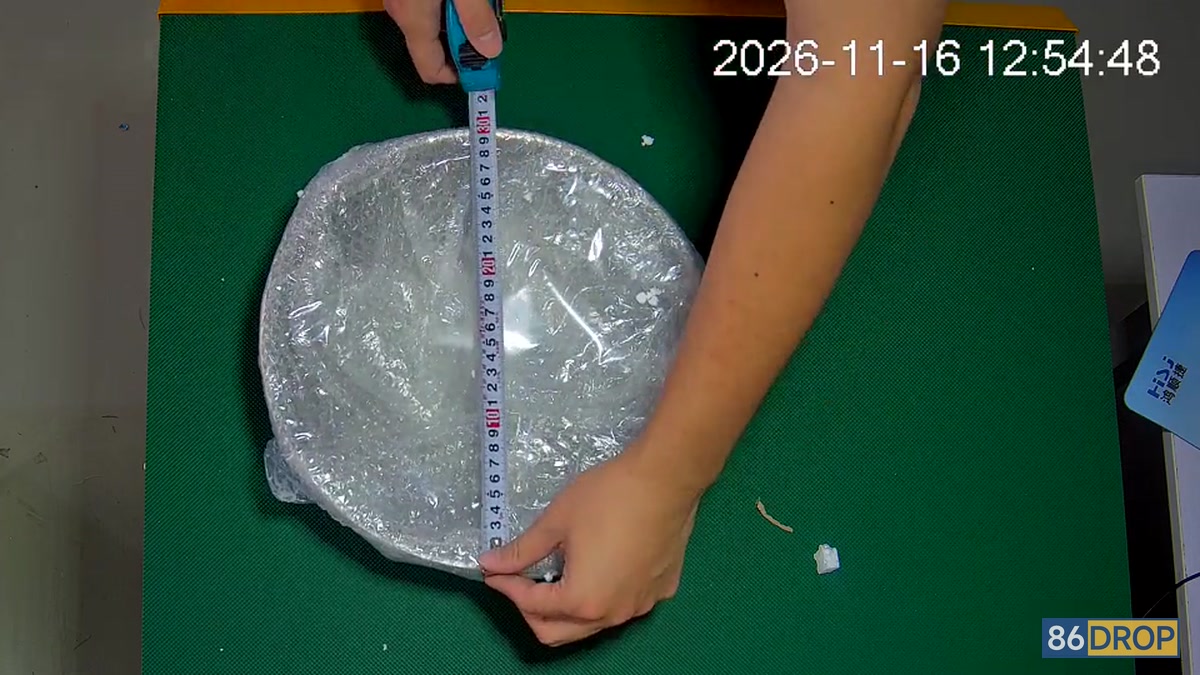
A tape measure laid across a bubble-wrapped pan gives you the width of the wrapped item. If your listing promises a 24 cm opening, the inspector needs access to the rim and a reference sheet showing where to measure. A photograph of the measurement gives you something concrete to check before dispatch.
Author disclosure. Wenlong Zhang writes as wenlongzhang and works with 86DROP. The company supplied its workflow description and the inspection footage used here. Its operational account has not been independently audited.
1. Why Cookware Quality Control Matters in Dropshipping
Cookware is a relatively complex product category for dropshipping. Unlike simple household accessories, a cookware set may contain multiple components, different materials, detachable fittings and fragile parts.
When a customer orders a cookware set, the merchant is responsible for ensuring that the product matches the listing and arrives in an acceptable condition.
Typical problems include:
- Missing lids, handles, screws or accessories.
- Incorrect sizes or product variants.
- Scratched or damaged non-stick coatings.
- Chipped enamel or dented stainless steel.
- Loose handles and poorly fitting lids.
- Warped bases.
- Broken glass lids during transportation.
- Incorrect product labels or specifications.
Use these examples to build the checklist for each SKU.
For dropshipping merchants, the consequences may include refunds, replacement shipments, customer service costs, payment disputes and negative reviews.
Responsibility for these checks falls at three points in an order’s life.
- Manufacturing quality: Whether the product was designed and manufactured safely.
- Fulfillment accuracy: Whether the correct product and accessories are selected and checked before dispatch.
- Transportation protection: Whether packaging provides adequate protection during shipping.
Warehouse inspection primarily addresses the second area and selected visible problems in the first and third areas.
2. What Product Recalls Tell Us About Cookware Risks
Official product recalls provide useful examples of cookware safety failures. They also illustrate why visual warehouse inspection should not be confused with engineering validation or laboratory testing.
Case 1: MSR Camping Cooking Pots — Handle Detachment
In February 2024, the US Consumer Product Safety Commission (CPSC) announced the recall of approximately 60,655 MSR camping cooking pots in the United States.
The handle could become loose or detach, creating a risk of hot food or liquid spilling onto users.
The company received 22 reports of handles becoming loose or detaching, including two reports of burn injuries. CPSC recall 24-126
Case 2: Granitestone Sauté Pans — Handle Screw Component Failure
In April 2026, CPSC announced the recall of approximately 740,000 Granitestone Diamond Pro Blue stainless steel sauté pans.
The metal cap on the screw connecting the pan to its handle could detach and forcefully eject when heated.
The company was aware of at least 98 incidents, including one report of bruising and burn injuries. CPSC recall 26-377
Case 3: H-E-B Sauté Pans — Glass Lid Breakage
In March 2019, H-E-B recalled approximately 12,000 Kitchen & Table sauté pans with glass lids.
The glass lid could crack or shatter during normal use, creating a laceration hazard.
H-E-B received eight reports of glass lids cracking or shattering, including one report of an eye injury. CPSC recall 19-080
What these cases actually demonstrate
These recalls should not be interpreted as evidence that warehouse visual inspection can prevent the same failures.
For example:
- A warehouse inspector may identify an obviously loose handle, but cannot necessarily detect a design weakness that causes a metal component to eject after heating.
- An inspector may identify visible chips or cracks in a glass lid, but cannot reliably detect all internal stresses that could cause it to fracture during normal use.
- A basic fitting check cannot establish the long-term mechanical strength of a handle connection.
These incidents demonstrate the importance of supplier qualification, product design validation, appropriate mechanical and thermal testing, and documented product-safety compliance.
Warehouse inspection remains useful for identifying visible damage, obvious assembly problems and fulfillment errors, but it cannot replace those controls.
3. What a Warehouse Inspection Can Verify
The following table describes the inspection methods currently reported by 86DROP and their practical limitations.
| Check | Method | What it can detect | What it cannot establish |
|---|---|---|---|
| Set completeness | Arrange items against merchant-supplied product images and SKU; photograph together | Missing lids, screws, handles and accessories | Whether the merchant’s original reference information is accurate |
| Weight | Compare against merchant-supplied reference weight | Significant deviations that may indicate missing components | Product quality or completeness by itself |
| Dimensions | Measure opening diameter and depth at agreed points; measure base diameter when specified | Obvious wrong-size or wrong-variant shipments | Manufacturing tolerances without defined specifications |
| Capacity | Measure with water and a measuring jug when requested | Obvious volume discrepancies | Precision volumetric certification |
| Surface condition | Visual inspection of non-stick, enamel, stainless steel and cast iron surfaces | Visible coating cuts, bubbles, peeling, enamel chips, dents, deep scratches and casting defects | Coating chemistry, migration, adhesion strength or long-term durability |
| Inside/outside identification | Side-lit close-up photographs | Location and appearance of suspicious marks | Whether an undocumented cosmetic defect is acceptable |
| Base flatness | Flat surface, opposite-side pressure and straightedge | Obvious rocking or warping | Thermal deformation or actual performance on every hob |
| Magnet screening | Apply a magnet to the base of induction-labelled cookware | Obvious lack of magnetic attraction | Full induction performance or compatibility certification |
| Lid fit | Fit the matching lid and inspect around the rim | Obvious gaps, catching or incorrect lid size | Steam retention or sealing performance |
| Glass lid | Inspect edges, glass surface and knob area | Visible cracks, chips and scratches | Hidden internal stresses or impact resistance |
| Handles and fittings | Check joints, screws, knobs and detachable locking mechanisms | Obvious looseness, missing screws and locking problems | Load capacity, fatigue resistance or lifetime strength |
| Sharp edges | Visually inspect rims, lids and handles and follow safe handling procedures | Obvious burrs and cutting edges | Complete product safety compliance |
| Odor | Open the package and check for abnormal smells | Conspicuous pungent or unusual odors | Chemical identification or emission levels |
| Labels and accessories | Compare markings, manuals, barcodes and agreed accessory lists | Incorrect models, missing parts and mismatched labels | Independent authentication of material composition or certification |
Important limitations
Reference information determines inspection accuracy.
For example, weight verification requires a reference weight from the merchant. If no reference weight is provided, the warehouse cannot perform a meaningful comparison.
Likewise, dimensions must be measured at agreed positions. A nominal 24 cm pan and a 26 cm pan should not be confused simply because their external shapes look similar.
Visual inspection is not material testing.
A non-stick coating may appear intact while still having underlying chemical or adhesion problems. A glass lid may look undamaged while containing internal stresses.
Basic functional checks are not durability tests.
Fitting a detachable handle and checking whether it locks can reveal obvious assembly problems. It does not establish whether the handle can withstand repeated loading, heating and long-term use.
4. The 86DROP Cookware Inspection Workflow
86DROP describes the following checks as available. Merchants should agree in writing which checks apply to each SKU and order.
4.1 Merchant reference information
Before inspection, the merchant should provide:
- Product images and SKU information.
- Model and size variations.
- Agreed measurement positions.
- Reference weight, where weight verification is required.
- Capacity requirements, where applicable.
- Included accessories and packaging requirements.
- Acceptable and unacceptable defect criteria.
The warehouse uses these references to compare the physical product with the merchant’s specifications.
4.2 Product completeness and identity
The cookware body, matching lid, steamer insert, detachable handle and included accessories are arranged together according to the merchant’s product images and SKU.
The set is photographed to help identify missing or incorrect components.
The weight is compared against the merchant’s reference weight. Significant deviations trigger further investigation.
Product dimensions are measured at agreed positions, including opening diameter and depth. Base contact diameter is measured only when specified in the product listing.
Product markings, hangtags, manuals and barcodes are compared with the merchant’s listing and system information.
4.3 Visible condition and functional checks
The described inspection includes:
- Non-stick coating cuts through to the underlying material, bubbles and peeling.
- Enamel chips exposing the base metal.
- Stainless steel dents and deep scratches.
- Cast-iron casting pits, flash and burrs.
- Suspicious marks photographed under side lighting, with their location identified as interior or exterior.
- Obvious base warping and rocking.
- Preliminary magnet screening for induction-labelled products.
- Matching lid fit.
- Glass lid cracks, chips and scratches.
- Long-handle joint looseness.
- Double-ear handle fasteners and missing screws.
- Lid-knob alignment and looseness.
- Physical attachment, locking and release of detachable handles.
- Obvious sharp burrs along rims and handle edges.
- Conspicuous abnormal odors, recorded in writing with a photo or video identifying the affected item for merchant review.
Capacity checks using water and a measuring jug are performed only when requested by the merchant.
4.4 Inspection evidence and exception handling
According to the supplied workflow, inspection photographs and pre-sealing product arrangement photographs are timestamped and retained for backend review.
When an issue is identified:
- The warehouse records the problem with photographic or video evidence.
- The evidence is sent to the merchant.
- The merchant decides whether to approve release or arrange a replacement.
- The order proceeds according to that decision.
For a cosmetic mark, the merchant can approve release against the agreed finish criteria. Keep recalled goods on hold and set aside any unit with a suspected safety defect while the concern is investigated.
The cost of replacement, return shipping, reshipment, additional inspection and storage should also be agreed in advance. These terms are contract-specific and have not been provided for this article.
5. Packaging Controls and Transportation Risks
Inspection and packaging address different problems.
A product that passes a visual inspection can still be damaged during international transportation. Packaging therefore needs to account for product weight, fragile components and possible contact between individual parts.
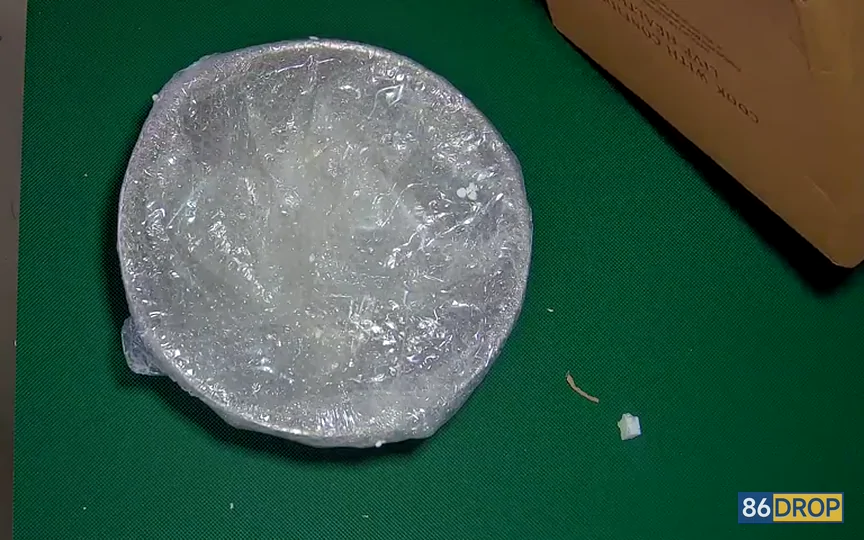
86DROP describes the following packing methods.
Glass lid protection
Glass lids are separately cushioned, isolated from heavy cookware and given sufficient clearance around raised knobs.
This reduces direct impact between the glass and other hard components. It does not guarantee resistance to all transportation impacts.
Nested cookware protection
Soft separators are placed between nested pots and pans. Loose metal accessories are secured separately.
This reduces rubbing and contact damage to cookware surfaces.
Long-handle protection
Long-handle ends are cushioned to maintain clearance from carton walls. Double-box protection may be used when appropriate for the shipping route and packaging plan.
Enamel rim protection
Rim protectors are reinstalled after inspection to reduce direct contact around vulnerable enamel edges.
When should merchants consider formal packaging tests?
For fragile or heavy cookware, merchants may consider laboratory-based packaging qualification.
Two relevant references are:
- ISTA Procedure 3A: Covers individual packaged products weighing 70 kg or less shipped through parcel delivery systems. ISTA currently lists the procedure as 3A (18-22). Confirm the revision with the testing laboratory. ISTA Procedure 3A
- ASTM D5276-19(2023): A free-fall drop test method for loaded boxes, cylindrical containers, bags and sacks. It can help evaluate the protective performance of packaging and inner packing. ASTM D5276
Neither standard should be presented as a certification of 86DROP’s existing packaging unless a relevant test has actually been completed and documented.
6. Product Safety and Regulatory Compliance: What Warehouse Inspection Cannot Replace
This is a critical distinction for merchants selling cookware internationally.
A warehouse inspector can check the visible condition of a product, but cannot determine its full chemical composition or certify that it meets every applicable food-contact requirement.
6.1 United States: FDA food-contact requirements
Cookware is considered a food-contact application under the FDA framework.
A food-contact substance that is regulated as a food additive must have an applicable authorization before being marketed in the United States.
The FDA also explains that certain PFAS have been evaluated and authorized for specific food-contact applications, including some non-stick cookware coatings. This is a substance- and use-specific assessment, not blanket approval of every PFAS chemical or every non-stick product.
Merchants should request relevant supplier documentation and verify that the actual material and intended conditions of use are covered. FDA guidance on food-contact substances · FDA questions and answers on PFAS in food
6.2 European Union: Food-contact materials
The main EU framework includes:
- Regulation (EC) No 1935/2004 on materials and articles intended to come into contact with food.
- Regulation (EC) No 2023/2006 on good manufacturing practice for food-contact materials.
- Regulation (EU) No 10/2011 for plastic materials and articles intended to come into contact with food, where applicable.
The framework addresses matters such as the migration of substances into food, material safety, manufacturing controls, traceability and supporting documentation.
The exact requirements depend on the material. Different rules may apply to plastics, ceramics, coatings and other materials. European Commission food-contact legislation
6.3 Physical product safety is a separate responsibility
Food-contact regulations should not be treated as a substitute for mechanical and physical product-safety requirements.
For example:
- A handle may detach under heat or load.
- A glass lid may fracture during normal use.
- A sharp edge may cause an injury.
- A detachable locking mechanism may fail.
In the EU, Regulation (EU) 2023/988, the General Product Safety Regulation (GPSR), provides a general safety framework for consumer products where specific EU safety provisions do not cover the relevant risks.
In the United States, CPSC administers product-safety requirements under the Consumer Product Safety Act. Manufacturers, importers, distributors and retailers may have reporting obligations when they obtain information about certain product hazards. EU General Product Safety Regulation · CPSC guidance on the duty to report
A visual warehouse inspection cannot replace supplier risk assessments, technical documentation or appropriate mechanical and thermal testing.
6.4 US state-level PFAS restrictions for cookware
PFAS regulations deserve particular attention when selling non-stick cookware into the United States.
PFAS is a broad family of chemicals. PTFE, commonly associated with traditional non-stick coatings, is one member of this family. Not every non-stick coating necessarily uses PFAS, so merchants should obtain the actual coating composition rather than relying on marketing descriptions.
Some state restrictions apply to products containing intentionally added PFAS. Their definitions, exceptions, product scope and effective dates differ.
The table summarizes six states’ cookware provisions as of November 28, 2026.
| State | Cookware-related effective date | Main requirement |
|---|---|---|
| Minnesota | January 1, 2025 | Prohibits cookware containing intentionally added PFAS, subject to the statutory scope and exceptions |
| Colorado | January 1, 2026 | Prohibits sale or distribution of cookware containing intentionally added PFAS |
| Maine | January 1, 2026 | Prohibits covered cookware products containing intentionally added PFAS, subject to statutory exemptions and applicable CUU determinations |
| Rhode Island | January 1, 2027 | Prohibits covered cookware containing intentionally added PFAS |
| Connecticut | July 1, 2026; January 1, 2028 | Notification and labeling requirements began in July 2026; the cookware sales prohibition begins in January 2028 |
| Vermont | July 1, 2028 | Cookware prohibition under the amended state statute |
Minnesota
Minnesota’s Amara’s Law prohibits the sale, offer for sale or distribution for sale of cookware containing intentionally added PFAS from January 1, 2025.
The Minnesota Pollution Control Agency explains that cookware includes products used to prepare, dispense or store food, foodstuffs or beverages.
Its guidance specifically identifies PTFE, marketed under the Teflon brand, as a member of the PFAS family subject to the cookware prohibition.
The guidance also distinguishes PFAS contained only in internal or electronic components from PFAS present in other parts of the product. Minnesota Pollution Control Agency cookware guidance
Colorado
Colorado’s SB24-081 establishes a January 1, 2026 prohibition on the sale or distribution of cookware containing intentionally added PFAS.
Merchants should review the current statutory wording and product scope before listing products for Colorado customers. Colorado Senate Bill 24-081
Maine
Maine’s cookware restriction took effect on January 1, 2026.
Maine DEP guidance defines covered cookware in relation to food-contact surfaces containing intentionally added PFAS. Certain internal components that do not contact food are treated differently under the 2026 prohibition and may fall under later requirements.
The law includes statutory exemptions and a Currently Unavoidable Use (CUU) process. Merchants should not assume that an exemption applies without checking the current approved determinations and product category.
Maine also has a specific importer-related rule: where a product is imported directly into Maine from outside the United States and the foreign company has no US presence, the importer may be treated as the manufacturer for the relevant program. Maine DEP guidance on PFAS in products · Maine statute, Title 38 § 1614
Rhode Island
Rhode Island’s cookware prohibition takes effect on January 1, 2027.
The Department of Environmental Management identifies products such as pots, pans, skillets, grills, baking sheets, baking molds, trays, bowls and cooking utensils as examples of covered cookware.
Its guidance also addresses electric cookware with PFAS intentionally added to food-contact surfaces. Rhode Island DEM guidance on PFAS in consumer products
Connecticut
Connecticut phases in its requirements over two dates.
- July 1, 2026: Manufacturers of covered cookware containing intentionally added PFAS must comply with applicable notification and product-labeling requirements.
- January 1, 2028: The prohibition on covered cookware containing intentionally added PFAS takes effect.
The labeling and notification requirements are already relevant to products marketed in Connecticut. Connecticut DEEP notification and labeling guidance
Vermont
Vermont’s cookware prohibition is scheduled for July 1, 2028 under the amended 9 V.S.A. § 2494f.
The general statutory framework became effective earlier, but the specific cookware prohibition has a later effective date. Vermont statute, 9 V.S.A. § 2494f
What this means for dropshipping merchants
A warehouse visual inspection cannot identify whether a non-stick coating contains intentionally added PFAS.
Merchants should request:
- Full coating and material composition.
- Supplier declarations identifying intentionally added PFAS.
- Supporting chemical analysis where necessary.
- Food-contact compliance documentation for the destination market.
- Confirmation that the product is not subject to an applicable state-level sales prohibition.
- Documentation supporting any claimed exemption.
A “PFOA-free” statement addresses one substance. Ask for evidence covering the full scope of any broader “PFAS-free” claim.
State requirements can change. Merchants should review the applicable statute and agency guidance for the destination state before listing or shipping cookware.
This section is a compliance overview, not legal advice or a complete survey of every US state.
7. Inspection Coverage and Acceptance Quality Limit (AQL)
Merchants should ask whether a provider performs 100% inspection or statistical sampling.
These are different services.
100% inspection means every item within the agreed inspection scope is checked.
Sampling inspection means only a selected number of units from a defined production lot are inspected. The result is used to make an acceptance decision about the lot under an agreed sampling plan.
A relevant international standard is ISO 2859-1:2026, the third edition published in January 2026. It provides sampling schemes indexed by Acceptance Quality Limit (AQL) for lot-by-lot inspection.
Under the standard, the lot size and agreed inspection level help determine the sample size. The plan and the selected AQL specify the acceptance and rejection numbers. Even an accepted lot can contain defective units.
For example, a supplier might inspect a sample from a production batch before sending inventory to a warehouse. That does not prove that the specific pan, lid and accessories in an individual dropshipping order have been checked.
For dropshipping merchants, the distinction is particularly important:
- Factory AQL sampling evaluates production lots.
- Warehouse order-level inspection checks the specific order within the agreed scope.
- Laboratory testing evaluates properties that ordinary visual inspection cannot establish.
These methods can complement one another, but they are not interchangeable. ISO 2859-1:2026 sampling standard
Merchants should ask providers to specify the inspection coverage for each SKU and order rather than relying on general statements such as “quality checked.”
8. Questions to Ask Any Cookware Inspection or Fulfillment Provider
Before signing an agreement, merchants should request clear written answers.
| Question | Why it matters |
|---|---|
| Is every order inspected or are products sampled? | Establishes actual coverage |
| Which inspection items are included for each SKU? | Defines the service scope |
| Who provides and validates the product specifications? | Determines the accuracy of the inspection reference |
| What happens if the merchant has not supplied specifications? | Prevents undefined acceptance decisions |
| How quickly are inspection exceptions reported? | Helps control fulfillment delays |
| Does the merchant make the final release decision? | Clarifies responsibility for flagged products |
| What are the inspection and rework fees? | Makes operating costs predictable |
| Who pays for replacement, return and reshipment? | Prevents commercial disputes |
| How many photographs are taken, and from which angles? | Establishes the evidence available |
| How long are inspection records retained? | Determines whether evidence remains available for later disputes |
| Can photographs be used in after-sales disputes? | Establishes their practical value |
| Is there a historical defect interception rate? | Helps evaluate actual inspection performance |
| Are anonymized inspection cases available? | Allows merchants to examine real examples |
| Are laboratory reports and supplier declarations available? | Covers risks outside warehouse inspection |
Which 86DROP service details should you confirm?
The following operating data have not been supplied for this article, and no public figures are cited here:
- Average inspection time per order.
- Inspection fees.
- Whether every cookware order receives 100% inspection or whether some checks are sampling-based.
- Historical defect interception rate.
- Number of photographs taken per order.
- Photo retention period.
- Publicly documented inspection case studies.
The described workflow includes timestamped inspection photographs and pre-sealing arrangement photographs retained for backend review. However, the exact retention period and access arrangements have not been specified.
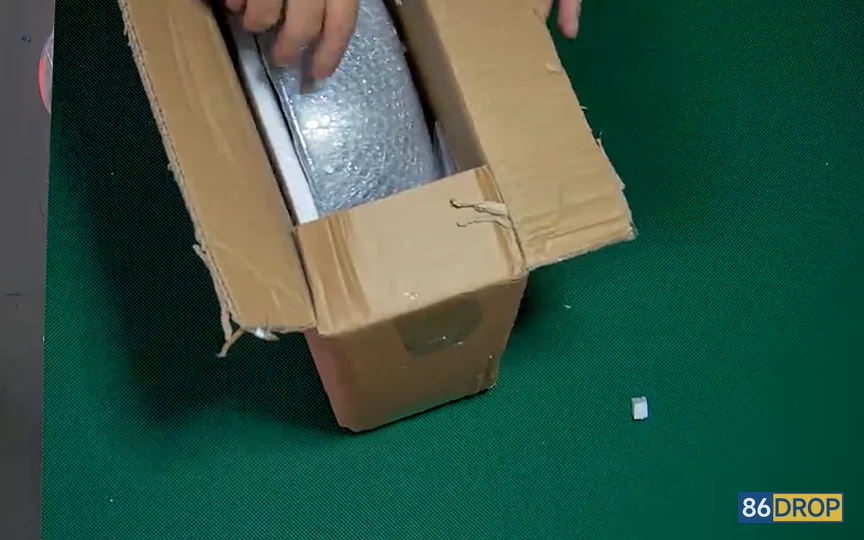
The three photographs in this article come from one 86DROP inspection video. They show an opened carton, a wrapped cookware component and a tape held across it. The SKU specification, recorded result and release decision would be needed to evaluate that order.
These details should be confirmed directly with the provider and recorded in the service agreement.
9. Choosing an Inspection Method
Different merchants have different quality-control requirements.
| Method | Advantages | Limitations | Best suited for |
|---|---|---|---|
| Merchant self-inspection | Direct control over standards and release decisions | Requires staff, space and handling time | Small operations and high-value products |
| Supplier in-line/final QC | Can identify manufacturing defects before dispatch | Supplier evaluates its own production | Established manufacturing relationships |
| Independent third-party inspection | Independent reporting and defined inspection scope | Additional cost and scheduling | Large batches and higher-risk products |
| Fulfillment-provider inspection | Checks can take place during order preparation and packing | Limited to the agreed manual inspection scope | Individual dropshipping orders |
Combining different methods
For higher-risk cookware, a layered approach may be more appropriate.
For example:
- The supplier provides material declarations and relevant product test reports.
- A third-party inspection agency evaluates production batches where justified.
- The fulfillment warehouse checks product identity, completeness, visible condition and packaging before dispatch.
This approach addresses different risk categories at different stages.
It also avoids relying on a single warehouse inspection to solve problems that require engineering or laboratory testing.
10. A Practical Decision Framework for Cookware Merchants
Before launching a cookware SKU, merchants should prepare a product-specific inspection reference sheet.
Product reference checklist
- Product name and SKU.
- Product and variant images.
- Model and size.
- Opening diameter and depth.
- Base contact diameter, where applicable.
- Reference weight.
- Advertised capacity and measurement method.
- Material and coating composition.
- Included accessories.
- Handle and lid specifications.
- Induction compatibility claim and supporting evidence.
- Acceptable cosmetic defect criteria.
- Packaging and protection requirements.
- Destination-market compliance documentation.
Establish defect severity
A merchant-side classification can help standardize exception handling.
| Classification | Examples | Suggested action |
|---|---|---|
| Critical safety concern | Cracked glass, dangerous sharp edges, suspected handle connection failure | Hold and investigate; do not release until the safety concern is resolved |
| Major functional defect | Wrong size, missing essential lid, detachable handle cannot lock, serious coating damage | Hold for merchant review or replacement |
| Minor cosmetic defect | Small exterior mark without an apparent functional or food-contact impact | Assess against agreed cosmetic criteria |
These categories are operational recommendations. They do not replace legal safety classifications or product-specific standards.
Review actual customer complaints
Merchants should classify returns and complaints by cause:
- Missing components.
- Incorrect size or variant.
- Surface scratches or coating damage.
- Broken glass lids.
- Loose handles or fittings.
- Packaging damage.
- Incorrect product descriptions.
- Product performance or material-safety concerns.
Reviewing these records regularly can help identify recurring supplier and packaging problems.
For example, repeated complaints about scratched cooking surfaces may indicate inadequate separation between nested products. Repeated glass-lid damage may indicate insufficient cushioning or a need for formal packaging testing.
The objective is to use actual complaint and return data to improve the inspection scope, supplier requirements and packaging design.
Before You Release a Cookware Order
Cookware quality control in dropshipping should not be judged by whether a provider simply claims to offer inspection.
Merchants need to understand what is inspected, how the checks are performed, what reference information is required, what evidence is retained and who decides whether a flagged product can be shipped.
The cookware workflow described by 86DROP includes component verification, reference-weight comparison, dimensional checks, visible defect inspection, basic fitting tests, timestamped photographic records and product-specific protective packaging.
These activities can identify certain fulfillment errors and visible problems before dispatch.
They cannot establish chemical safety, coating durability, hidden structural integrity, long-term handle strength, full induction performance or guaranteed transportation protection.
For merchants considering 86DROP or another fulfillment partner, the appropriate next step is to request actual inspection evidence, a written coverage specification, commercial terms and examples of exception handling.
For a trial order, ask for one complete record showing the SKU, the measurement points, the photographs and the release decision. Compare it with the checks you agreed to buy.