
Found something on 1688 that you want to sell on Shopify? Start by asking whether the supplier will ship one unit of the exact variant to your US customer, with tracking and clear duty terms. Alibaba Group describes 1688 as a domestic wholesale marketplace. Some suppliers or intermediaries may offer international shipping, but don’t assume a listing includes it.
If the seller only ships within China, you can have the supplier send your goods to a warehouse in China. You or a sourcing agent buys the stock; the warehouse receives it, does the agreed checks, and ships individual Shopify orders. This guide follows one example: a black zippered fabric pouch, SKU POUCH-BLK, sold to US shoppers. The quantities below are illustrative.
Who should handle the first shipment?
| What the supplier can do | Who handles purchasing and fulfillment? | Confirm before you go live |
|---|---|---|
| Packs and ships individual orders to the US | Buy from the supplier and ask them to dispatch each order | Can they ship the exact SKU with tracking? Who pays import charges, and who handles a damaged or wrong item? |
| Ships only within China, but you can purchase and manage the supplier | Buy directly; have a China warehouse receive and fulfill your orders | Get receiving instructions, agree the inspection scope, and confirm which stock is available for sale. |
| Ships only within China and you need help buying or checking the goods | Ask a sourcing agent to purchase; arrange warehouse fulfillment with that team or a separate partner | Get an itemized quote and agree who owns supplier follow-up, rejected units, and shipment exceptions. |
1. Get a quote for the exact pouch and approve a sample
Send the supplier the listing URL, reference photos, dimensions, fabric, zip color, and intended quantity. Ask if the quoted price is for that exact version or just the cheapest option on the listing. Get the minimum order quantity (MOQ) for black, not just for the listing as a whole. Check whether a plain sample, plain stock, and custom-branded stock have different minimums or lead times.
Ask two separate questions: “Can I buy one?” and “Can the warehouse ship one at a time?” A supplier may sell only by the carton even when a warehouse can dispatch one pouch per Shopify order. If the minimum applies to a mixed-color carton, get the black quantity in writing. If the supplier can’t replenish the approved version in quantities you can afford to hold, keep that variant off sale until you have a workable source.
Ask who makes the pouch, who sells it, what they have ready now, and how they handle defects found on receipt. Check the business details and ask the supplier to confirm the sample and batch specifications in writing. Open and close the sample zipper, check the stitching, measure the pouch, and photograph the approved details. Keep those photos with the purchase instructions so the warehouse knows which pouch to accept. A visual check doesn’t establish safety or regulatory compliance; confirm any product-specific requirements separately before selling.
2. Price the delivered order, not just the 1688 listing
Ask for the quote in separate lines. Confirm the currency, which costs are charged once or by batch, and which repeat on every order.
| Quote line | What to confirm for POUCH-BLK |
|---|---|
| Product and purchasing | Price for the exact variant and quantity; sample cost; agent or payment fees, if any |
| Supplier to warehouse | Domestic freight in China and who pays it |
| Receiving and storage | Receiving charges; agreed inspection scope; any storage, rework, or rejected-stock fees |
| Order preparation | Pick and pack, protective packaging, and any inserts or branding |
| US shipment | Service, destination ZIP code, packed weight and dimensions, billable weight, tracking, and surcharges |
| Import charges and exceptions | Who pays applicable duties, taxes, and brokerage; what happens if a parcel is refused, lost, or returned |
Get the final parcel measurements with the actual packaging before choosing a shipping option. If you’re comparing two quotes, use the same packed parcel, ZIP code, and import-charge assumptions for both. Divide the shared inbound costs by the number of units you can actually sell after inspection. Then add the order-level costs. That gives you a better basis for deciding what to charge at checkout.
For example, two suppliers quote the same total T for 30 pouches, including China delivery and agreed intake checks. Supplier A’s batch has 27 sellable units, with no credit yet agreed; B’s has 30. The inventory cost per sellable pouch is T ÷ 27 versus T ÷ 30. That’s about 11% higher for A before picking, packing and outbound freight, despite identical quotes. A supplier credit would change the calculation; count it only once agreed. Compare both routes using the same packed parcel, ZIP code and duty payer.
Confirm the carrier’s billing terms before promising that the shopper won’t pay on delivery. UPS explains how duties and fees can be billed. Ask the carrier or broker to confirm the applicable charges and who pays them for your product and service. See the China-to-US fulfillment guide for a fuller cost comparison.
3. Give the warehouse enough information to receive the first batch
Before the supplier dispatches, send the warehouse your SKU, approved sample photos, expected quantity, supplier’s shipment reference, and the checks you want performed. Ask how the supplier should identify each carton. For the pouch, the checks could include the color, size, zipper, and visible seams. Agree what happens if they find a missing unit or a zipper that sticks: hold the affected units, record the issue, and confirm whether to return, replace, or accept them.
Make the sellable quantity the number that passed receiving, not the number the supplier said they sent. Ask how you’ll see the inspection record and which details it contains. For an example of what a warehouse can document, see 86DROP’s quality checks.
4. Send one real parcel before opening sales
Set up the Shopify product with the correct variant and match it to the warehouse SKU. Confirm which location or app fulfills that SKU and whether the selected US ZIP code can check out with the intended shipping rate. Shopify explains how routing and available inventory determine the fulfillment location.
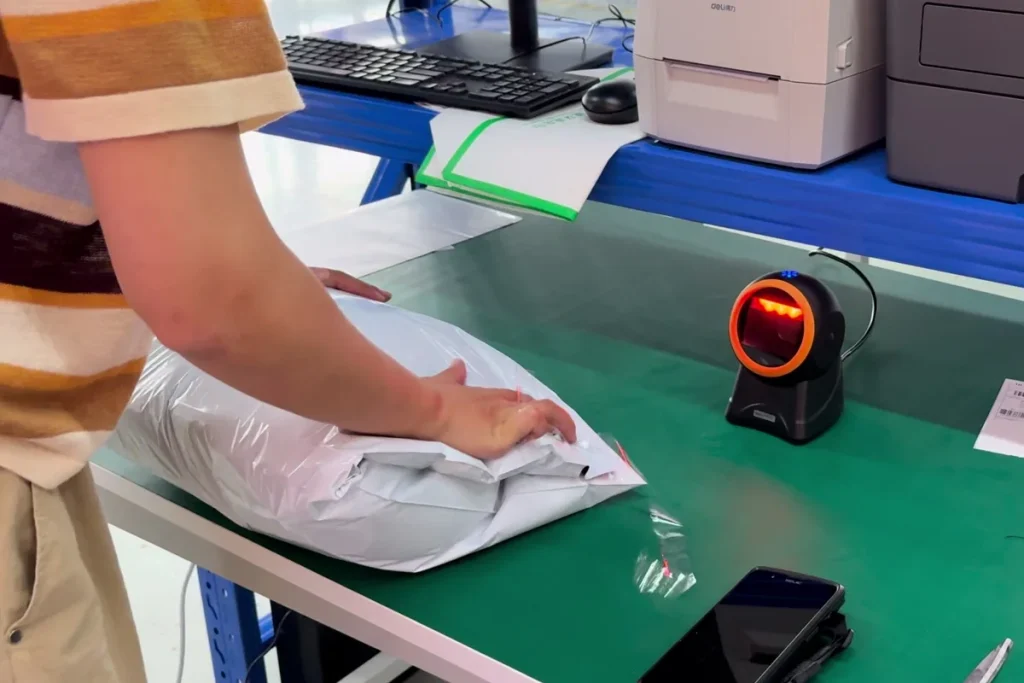
Place a controlled order to an address you can use, and have the warehouse actually send the pouch. A test that stops at checkout can’t tell you whether the physical parcel made it to the carrier. Check that:
- The warehouse received the right SKU and quantity, and picked the black pouch you approved.
- The packer used the agreed packaging and the parcel measurements match the shipping quote.
- The tracking number appears on the right order, and the carrier shows that it received the parcel. If it only says “Label Created,” check the handoff before telling the customer it shipped.
- The pouch arrives in the expected condition, with any import charges handled as quoted. Note who would handle a failed delivery or return.
Use the failure to decide what to fix. No rate at checkout? Check the shipping profile, destination and fulfillment location before releasing the order. Wrong SKU in the warehouse queue? Pause that variant and reconcile the Shopify mapping against the warehouse record. Label created without carrier acceptance? Look for a parcel-level handoff record before classifying it as shipped. One successful parcel verifies the tested route; it doesn’t establish a delivery promise for every ZIP code.
With 86DROP, send the 1688 listing and your approved specs through Product Sourcing. Once your Shopify store is connected and the products are mapped, the Shopify integration syncs Shopify orders and tracking updates. The purchase and the warehouse setup come first.